

Walk through any market in Istanbul, Athens or Marrakesh and you will see them everywhere: glass beads with a blue eye staring back at you. They hang from car mirrors, baby strollers and shop doors. Today they also hang from the wrists of celebrities and influencers who may have no idea what the symbol means.
I grew up in a culture where the evil eye is not a fashion trend. It is something grandmothers whisper about when a child suddenly falls ill after a compliment. So what is the evil eye, really? Does Islam believe in it? And if it does, why do so many Muslim scholars say the famous blue charm is forbidden?
In this article
The short answer
The evil eye is the belief that an envious or admiring look can cause harm to a person or their belongings. Islam accepts that the evil eye is real, based on the Prophet Muhammad’s words “The evil eye is real” (Sahih Muslim). But Islam rejects the nazar bead and other amulets. Its protection is spoken, not worn: saying “Masha Allah” when you admire something, daily remembrance of God, and ruqyah (Quranic recitation) if someone is affected.
What does the evil eye mean?
The idea is simple and very old. Someone looks at what you have, your child, your health, your new car, with envy or even with strong admiration. Something bad follows.
Encyclopaedia Britannica notes that in many traditions the power of the evil eye can be involuntary. It tells of a Slavic folktale in which a father, believing he carried the evil eye, blinded himself so he would not hurt his own children.
The belief is far older than any modern religion. Texts from the ancient city of Ugarit in Syria already mention it, and Greek and Roman writers discussed it at length, according to the Wikipedia overview of the evil eye.
How many people believe in it today?
More than you might think. In 2022 economist Boris Gershman published a study in PLOS ONE based on surveys of more than 140,000 people in 95 countries. They were asked whether they believe in “the evil eye, or that certain people can cast curses or spells that cause bad things to happen to someone.”
Over 40% said yes. The country average was 43%, ranging from 9% in Sweden to 90% in Tunisia. Belief was less common among people with more education and economic security, and more common where trust in institutions was low.
Is the evil eye real in Islam?
Yes. This is one of the points where Islam takes a clear position. The Prophet Muhammad said: “The evil eye is real, and if anything were to overtake the divine decree, it would be the evil eye” (Sahih Muslim). The Quran also teaches believers to seek refuge “from the evil of an envier when he envies” (Quran 113:5).
IslamQA defines the evil eye as a person harming another with his eye: it starts when he likes something, and his feelings affect it through repeated looking.
Envy and the evil eye are not the same thing
Classical scholars made a useful distinction. The 14th-century scholar Ibn al-Qayyim, in his book al-Tibb al-Nabawi (Prophetic Medicine), explains that everyone who casts the evil eye is envious, but not every envious person casts the evil eye. Envy is the feeling. The evil eye is one way that feeling can cause harm.
He adds something surprising: the evil eye can come from a person who loves you, and even from someone who has only heard you described. That is why Islamic tradition does not treat the evil eye as a “witch” problem. It is a human problem. Anyone can do it, even by accident.

Why Muslims don’t need the blue charm
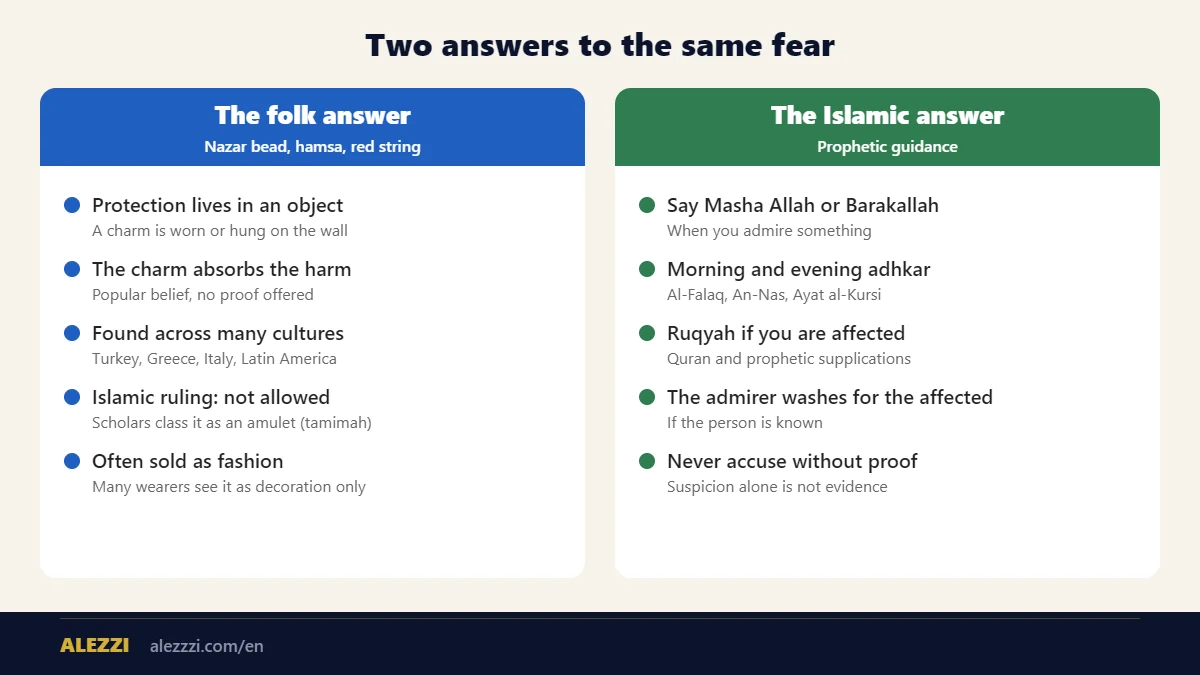
Here is where the Islamic view parts ways with folklore. The nazar bead, the hamsa hand and similar objects are what Islamic law calls a tamimah, an amulet.
IslamQA cites a hadith in Musnad Ahmad in which the Prophet refused to accept a man’s pledge until he removed an amulet, saying: “Whoever wears an amulet has committed shirk” (associating partners with God). The reason is simple. In Islam, protection and harm come from God alone. Hanging that power on a glass bead contradicts that belief.
IslamWeb answered a question about the “science” behind the blue bead, the claim that blue absorbs harmful waves. Its answer: wearing it is impermissible, like any amulet, and may amount to minor or major shirk depending on what the wearer believes.
And another IslamQA answer says jewelry shaped like an eye or a hand, or containing blue beads, should not be worn even as decoration, because others will assume it is worn to ward off the evil eye.
How Islam protects against the evil eye
The Islamic method is practical and costs nothing:
- Say “Masha Allah” or “Barakallahu fih”. When something impresses you, mention God and pray for blessing. The Prophet told a companion who had admired someone: “If you see something you like, pray for blessing for him.”
- Keep the daily remembrances. Morning and evening recitation of Ayat al-Kursi and the last three surahs of the Quran (al-Ikhlas, al-Falaq and an-Nas).
- Use ruqyah if someone is affected. Ruqyah is recitation of the Quran and prophetic supplications over the person. IslamQA lists it as the first means of treatment.
- Ask the admirer to wash, if known. In the hadith of Sahl ibn Hunayf, recorded by Malik and Ibn Majah, the man who admired him was told to wash, and the water was poured over the one affected.
- Do not show off, and do not panic. Ibn al-Qayyim recommends covering one’s good fortune from envious eyes. But he also teaches that trust in God is the strongest shield.

Does science support the evil eye?
No scientific study has measured a harmful “ray” from the eye, and Islamic scholars do not claim one. For believers, the evil eye works by God’s permission, not by physics. That is why the blue bead’s “wave absorption” explanation is rejected by both science and Islamic scholarship.
What science can say is that fear of the evil eye has real effects. Gershman’s study found that countries with stronger belief also report more worry and a greater feeling of lacking control over life. Living in constant suspicion of your neighbors is a burden of its own.
A word of caution
If you feel unwell, see a doctor first. Headaches, fatigue and anxiety have many ordinary causes. Islamic teaching allows ruqyah alongside medicine, never instead of it. And it strictly forbids accusing a specific person of casting the evil eye without proof. A suspicion can destroy a family faster than any glance.
Frequently asked questions
What does the evil eye mean?
It is the belief that an envious or admiring look can bring harm, illness or bad luck to a person or their possessions. The belief appears across the Middle East, the Mediterranean, South Asia and Latin America.
Is it haram to wear an evil eye bracelet?
Many Muslim scholars say yes. IslamQA and IslamWeb class the nazar bead as an amulet, which the Prophet forbade, and IslamQA advises against wearing it even as jewelry.
What do Muslims say to avoid the evil eye?
“Masha Allah” (what God has willed) and “Barakallahu fih” (may God bless it) when admiring something, along with daily recitation of Ayat al-Kursi and the last three surahs of the Quran.
Can someone give you the evil eye without meaning to?
Yes. Islamic scholars, including Ibn al-Qayyim, note that it can come from a loving person who simply forgot to mention God.
Where does the blue evil eye come from?
Eye-shaped charms against harm are very old in the Mediterranean and Middle East. The modern glass nazar is especially associated with Turkey, Greece and their neighbors.
What is the difference between envy and the evil eye?
Envy is the feeling of wanting someone’s blessing to disappear. The evil eye is harm that can result from a look. Every caster of the evil eye is envious, but not every envious person casts it.
Related reading
- Ruqyah Explained: Meaning, Authentic Duas and How to Do It Yourself
- What Are Jinn? The Islamic Belief vs the Genie in the Lamp
- The Sleep Paralysis Demon: Why People Everywhere See the Same Figure
- How Do Magicians Read Minds? The 5 Real Methods Behind Mentalism
- Hungry Ghost Festival vs Day of the Dead vs Halloween
- Joss Paper and Hell Money: Why Chinese People Burn Paper Money for the Dead