
As a young man, Ray Hyman read palms for money. At first he did not believe in it. But his clients kept telling him his readings were uncannily accurate, and by college he was a believer.
Then a friend suggested an experiment: read the next palm backwards. Say the opposite of what the lines are supposed to mean. Hyman did. The client was delighted with how well he had captured her. So were the next few. Hyman concluded that whatever was happening had nothing to do with the hand, switched his major to psychology, and became one of the best-known experts on how “psychic” readings work.
That story is the key to every mind-reading act you have ever seen. So how do magicians read minds? Here are the five real methods, explained by people who perform magic, not people who sell it.
In this article
- The short answer
- 1. Cold reading: saying what fits everyone
- 2. Psychological forcing: the choice that isn’t free
- 3. Muscle reading: your body answers for you
- 4. Hot reading: the homework before the show
- 5. Secret props and accomplices
- Can anyone really read minds?
- How to spot fake mind reading
- Frequently asked questions
- Related reading
The short answer
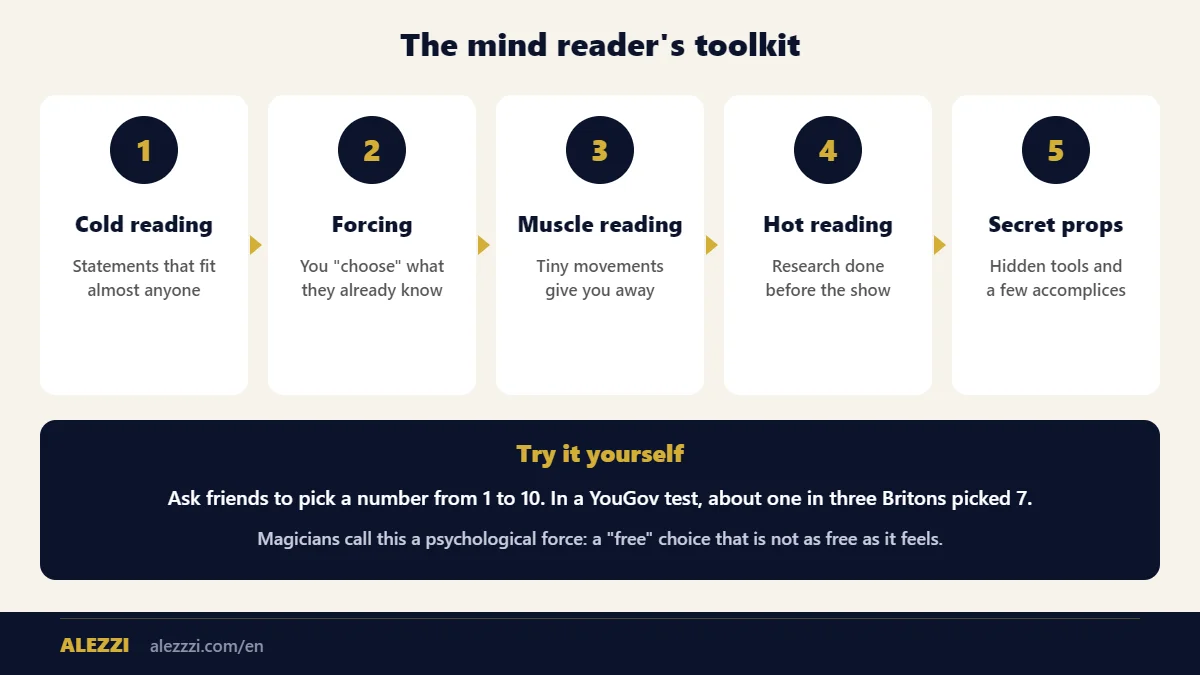
Magicians read minds by combining psychology and method, not telepathy. The main tools are cold reading (statements that fit almost anyone), psychological forcing (steering your “free” choice), muscle reading (feeling tiny involuntary movements), hot reading (research done in advance), and secret props or accomplices. Most performers use several at once, which is why the effect feels impossible.
1. Cold reading: saying what fits everyone
Cold reading is, in Hyman’s own definition, a procedure by which a reader persuades a stranger that he knows all about their personality and problems. His 1977 article in the Skeptical Inquirer, “Cold Reading: How to Convince Strangers That You Know All About Them”, is still the classic guide.
The engine behind it is the Barnum effect. In 1948 psychologist Bertram Forer gave his students a personality test, then handed each of them a “personal” profile. Every student got the same text, copied from an astrology book. On a scale of 0 to 5, they rated its accuracy at about 4.3 on average, according to the Wikipedia summary of the Barnum effect.
A mind reader adds observation. Your age, clothes, ring, accent and reactions all narrow the guesses. When a vague statement lands, your face tells him, and he goes deeper. When it misses, he moves on, and you forget the miss.
2. Psychological forcing: the choice that isn’t free
“Think of any number from one to ten.” It sounds like a free choice. It isn’t.
In a YouGov test, a third of Britons picked seven, and people avoided the numbers at the edges of the range. Psychologists have described a similar “blue-seven” pattern since the 1970s, although researchers still dispute how strong it is.
A good performer stacks these biases. The wording, the pace, the gestures and even the examples he mentions all push you toward one answer. If you land elsewhere, he has an “out” ready, and the audience never knows.

3. Muscle reading: your body answers for you
This is the oldest true “mind reading” technique, and it is real in its own way. The performer holds your wrist while you think about where an object is hidden. As you imagine the path, your muscles make tiny movements you do not notice. The performer follows the path of least resistance and finds the object.
The Library of Congress describes how 19th-century performers such as J. Randall Brown and Stuart Cumberland built careers on this technique. Cumberland used it to argue against spiritualism: he insisted telepathy was impossible and that muscle reading was the scientific explanation. Psychologists call the underlying effect the ideomotor response, the same effect that moves a Ouija board planchette.
4. Hot reading: the homework before the show
Some “readings” are not cold at all. The performer, or someone working with him, gathers information in advance: social media profiles, conversations in the lobby, details on booking forms. On stage it sounds like a revelation.
On stage this is entertainment. Off stage it is how fraudulent psychics have convinced grieving families that they were in contact with the dead.
5. Secret props and accomplices
Finally, there is the hardware: marked cards, hidden writing tools that copy what you write, devices that let a performer peek at a folded paper, and occasionally a helper in the audience. Magicians guard these methods closely, but the principle is simple. If information seems to travel from your head to theirs, look for the physical path it might have taken.

Can anyone really read minds?
No reliable evidence shows that anyone can read thoughts directly. The most honest mentalists say so themselves. Many prefer to describe what they do as “reading people”, which is exactly what the five methods above add up to.
That honesty is the line between a performer and a fraud. A magician says “this is a trick” and lets you enjoy the puzzle. A fraud says “this is a gift” and asks for your money or your trust.
How to spot fake mind reading
- Write down every statement. Afterwards, count the hits and misses. Most readings look far less accurate on paper.
- Notice who supplies the details. If you gave the names and facts and the reader repeated them back, that is cold reading.
- Watch for vague openings. “I’m sensing an older man connected to you” fits nearly everyone.
- Ask what they knew in advance. Booking forms, social media and lobby chat are common sources.
- Never pay for “secret” knowledge. Entertainment is fine. Life decisions based on a reading are not.
Frequently asked questions
How do magicians read minds?
They use psychology and method: cold reading, psychological forcing, muscle reading, research in advance and hidden props. Combining several methods makes the result look impossible.
What is cold reading?
It is a set of techniques that lets a reader convince a stranger that he knows them, using general statements, observation and the person’s own reactions. Psychologist Ray Hyman described it in a classic 1977 article.
Why do most people pick 7?
Nobody knows for sure, but surveys repeatedly show seven is over-chosen. In one YouGov test, a third of Britons picked it.
Is mentalism real or fake?
Mentalism is real as an art form and fake as telepathy. Performers use real psychological skills to create the illusion of mind reading.
What is muscle reading?
A technique where the performer holds a person’s wrist and follows tiny unconscious movements to find a hidden object or chosen target. It relies on the ideomotor response.
Can I learn to read minds like a magician?
You can learn the methods. Cold reading and forcing take practice, and muscle reading needs a sensitive touch. What you cannot learn is real telepathy, because there is no good evidence it exists.
Related reading
- How Did Houdini Die? The Punch, the Appendix and the Halloween Legend
- How Do Magicians Levitate People? 3 Levitation Tricks Explained
- How Do Magicians Guess Your Card? 3 Classic Principles You Can Learn Tonight
- The Sleep Paralysis Demon: Why People Everywhere See the Same Figure
- The Evil Eye Meaning in Islam, and Why Muslims Don’t Need the Blue Charm