Walk into a Chinese grocery store anywhere from Singapore to San Francisco and you may spot them near the incense: thick bundles of colorful banknotes printed with the words “Hell Bank Note” and a face that is definitely not a president. The denominations are absurd. Ten thousand. Five hundred million. Sometimes billions.
Nobody spends this money in a shop. It is bought to be burned, and the people burning it believe it will reach someone who died.
Here is everything you need to know about joss paper and hell money: what it is, why Chinese families burn it, when they do it, what the strange designs mean, and the etiquette that can save you from an embarrassing mistake.
In this article
- The quick answer
- What is joss paper?
- What is hell money?
- Why do Chinese people burn paper money?
- A 1,300-year-old tradition in one minute
- When is joss paper burned?
- How to burn joss paper respectfully
- The etiquette mistake you must not make
- Do people really believe it?
- Joss paper on screen
- Watch: joss paper and hell money explained
- Frequently asked questions
- What is the difference between joss paper and hell money?
- Why is it called ghost money?
- Is it bad luck to have hell money at home?
- Can non-Chinese people burn joss paper?
- When is the Hungry Ghost Festival in 2027?
- What do the faces on hell bank notes mean?
- Why are hell bank notes worth billions?
- Is burning joss paper religious?
- More from the afterlife
The quick answer
Joss paper (also called spirit money, ghost money or ancestor money) is paper made to be burned as an offering to ancestors, gods and wandering spirits in Chinese folk religion. Families believe the smoke carries it to the afterlife, where the dead can use it. Hell money, or hell bank notes, is a modern type of joss paper printed to look like real banknotes. It is burned at funerals, during the Qingming Festival in April, and above all during the Hungry Ghost Festival.
What is joss paper?
Joss paper is the general name for paper offerings burned in Chinese rituals. In Mandarin it is often called zhiqian (紙錢), literally “paper money.” According to Duke University’s Intersections project, most traditional joss paper is made from coarse bamboo paper, with a square of gold or silver foil on one side.
There are different kinds for different spirits. Culture Trip describes three main types of ghost money: copper for newly deceased and unknown spirits, gold for the deceased and higher gods, and silver for ancestral spirits and local deities.
And joss paper is not only money. Families also burn paper houses, clothes, cars, servants, mahjong sets and, today, paper smartphones, designer handbags and even credit cards.
What is hell money?
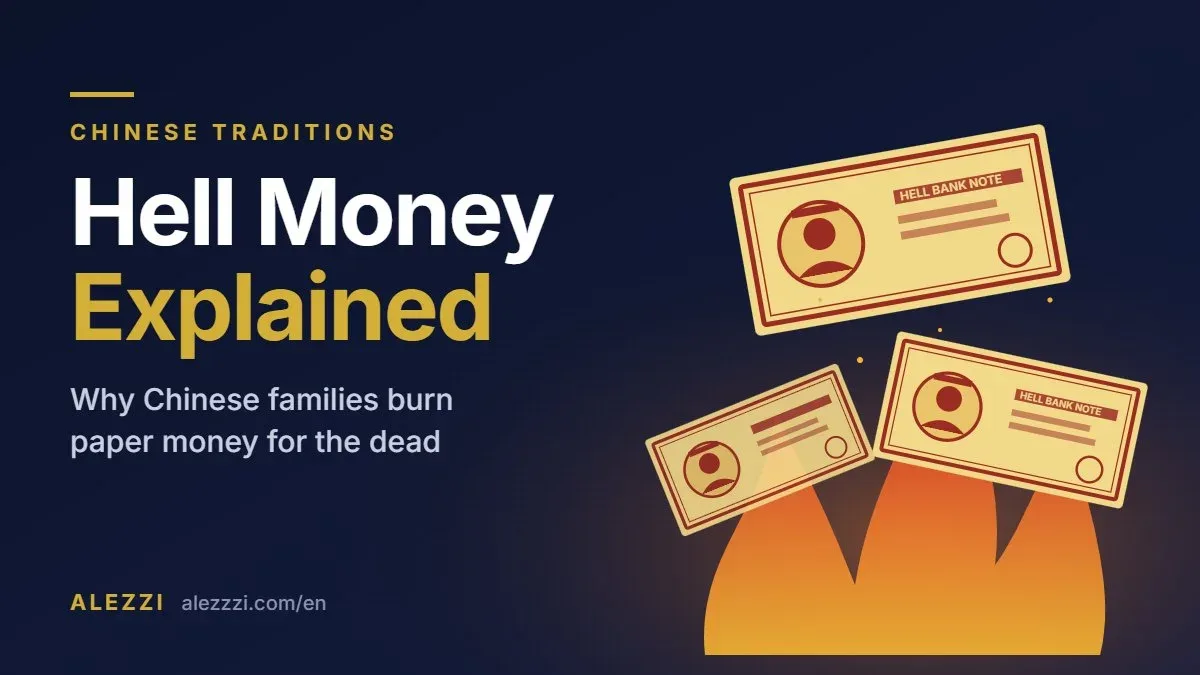
Hell money is the most famous form of joss paper outside Asia, because it looks so much like real cash. Modern hell bank notes come in huge denominations, from 10,000 to several billion. The front usually shows the Jade Emperor, ruler of heaven in Taoism, and the back shows the “Bank of Hell.” Many notes also carry the signature of Yanluo, the King of Hell.
Some printers go further. Notes have been printed in US dollars, Chinese yuan and other currencies, and some even carry celebrity faces. Collectors trade them, and the British Museum keeps hell bank notes in its collection.
Why is it called “hell” money?
For English speakers, “hell” sounds like a threat. In Chinese belief, it is not. The word refers to Diyu, the underworld, which is imagined less as a place of eternal fire and more as a giant government office where souls are judged, sentenced and eventually reborn. As Wikipedia’s article on hell money notes, the label “hell bank note” is largely a Western idea. In Chinese, it is simply another kind of joss paper.
A popular explanation, repeated by many writers, is that Western missionaries told Chinese converts that unbelievers would go to “hell,” and printers simply adopted the English word for the afterlife. Whatever the origin, the name stuck.
Why do Chinese people burn paper money?
The core belief is simple: the dead still have needs. They need a home, clothes, food and money, just as they did when they were alive. Burning turns the paper into smoke, and the smoke carries the offering into the world of the dead.
The afterlife in Chinese folk religion was imagined as a copy of the imperial bureaucracy, complete with judges, gatekeepers, officials and, of course, bribes. Money helped the dead pay their way, ease their punishment and live comfortably while they waited for rebirth. In the early 20th century, the French Jesuit Henri Doré recorded a Chinese scholar explaining exactly that: burnt paper money is the currency of the spirits, used to bribe the guards of the underworld. We tell that story in full in Paper Money for the Dead: Inside Old China’s Afterlife Economy.
But for most families today, the meaning is closer to love than to bookkeeping. Burning joss paper is a way of saying: we have not forgotten you, and we are still taking care of you.
A 1,300-year-old tradition in one minute
- Before paper: wealthy families buried real coins and silver with the dead, which attracted tomb robbers.
- Han dynasty: paper was invented. Over the following centuries, some people began cutting paper into coin shapes for the spirits.
- Tang dynasty (8th century): burning paper money entered imperial rituals, and the custom spread across China.
- Song dynasty: shops selling paper offerings became common, and paper gold and silver ingots joined the paper coins.
- 20th century to today: printed hell bank notes, paper mansions, paper cars and paper iPhones.
When is joss paper burned?
| Occasion | When | What happens |
|---|---|---|
| Funerals and memorial days | At the funeral and on set days after a death, such as the 49th day | Money, a paper house and daily necessities are burned for the newly deceased |
| Qingming (Tomb-Sweeping Day) | Early April | Families clean ancestors’ graves and burn offerings |
| Hungry Ghost Festival | 15th day of the 7th lunar month (16 August 2027) | Offerings for ancestors and for wandering ghosts with no family |
| Winter Clothes Festival | 1st day of the 10th lunar month | Paper winter clothes are burned so ancestors stay warm |
| Lunar New Year and family anniversaries | Varies | Offerings at home altars and temples |
The Hungry Ghost Festival
The biggest joss paper season of the year is Ghost Month, the seventh month of the Chinese lunar calendar, when the gates of the underworld are believed to open and spirits wander the earth. Its peak is the Hungry Ghost Festival, which falls on Monday 16 August in 2027.
The “hungry ghosts” are spirits with no descendants to feed them, or who died violently or unhappily. Families burn offerings not only for their own ancestors but also for these forgotten souls, to keep them calm and away from the living. In Hong Kong, Singapore, Malaysia and Taiwan you will see metal bins burning on the sidewalks and street-side stages with Chinese opera performed for the ghosts. Time Out Hong Kong has a good guide to what you will see on the streets.
How to burn joss paper respectfully
Customs vary by family, region and dialect group, so always follow the lead of the people you are with. But these points are common:
- Fold it. Joss paper is often folded before it is burned, partly to distinguish it from real money.
- Use a proper burner. Families and temples use metal bins or special furnaces, both for safety and so the offering is kept together.
- Say who it is for. Many people speak the name of the person they are sending it to, so it reaches the right recipient.
- Never burn real money. Burning genuine currency is considered disrespectful and unlucky in much of Asia.
- Let it burn out completely. Do not walk away from a burner that is still alight.
The etiquette mistake you must not make
Never give hell money to a living person. It may look like a funny souvenir, but handing someone hell bank notes is considered a serious insult in Chinese culture, and in some places it is read as wishing them dead. It is definitely not a gift for an older relative or a Chinese colleague.
Do people really believe it?
It depends who you ask. Some families believe quite literally that the money arrives. Some report that a dead relative appeared in a dream asking for a specific item, and they rushed to the joss paper shop to buy a paper version. Others see it purely as tradition and a way of remembering.
Either way, the custom has stayed remarkably alive. If anything, it keeps modernizing. Shops in Hong Kong and Malaysia sell paper versions of the latest phones, sneakers and luxury bags, because the dead, apparently, like to keep up with fashion too.
Joss paper on screen
If you want to see this world come alive, watch The Ghost Bride (Netflix, 2020), based on Yangsze Choo’s novel and set in colonial Malacca. Its heroine is pulled into a ghost marriage and travels through an afterlife shaped by Chinese beliefs about the dead, the same beliefs that make families burn paper offerings for them.
Watch: joss paper and hell money explained
How Chinese people send money to the dead (Goldthread)

Hell money for hungry ghosts (TODAYonline)

Frequently asked questions
What is the difference between joss paper and hell money?
Joss paper is the general name for all paper offerings burned for spirits. Hell money, or hell bank notes, is one modern type of joss paper designed to look like printed banknotes.
Why is it called ghost money?
Because it is money meant for ghosts and spirits, not for the living. It is also called spirit money and ancestor money.
Is it bad luck to have hell money at home?
Hell money is meant to be burned for the dead, so many Chinese families would find it uncomfortable to keep it as decoration, and giving it to a living person is considered an insult. Collectors do keep it, and museums like the British Museum hold examples.
Can non-Chinese people burn joss paper?
Yes. Anyone can make an offering to honor someone who has died. If you are joining a Chinese family’s ritual, follow their customs and ask what is appropriate.
When is the Hungry Ghost Festival in 2027?
Monday 16 August 2027, the 15th day of the seventh lunar month. Ghost Month as a whole lasts the entire seventh lunar month around it.
What do the faces on hell bank notes mean?
Most notes show the Jade Emperor, the ruler of heaven in Taoism, and many carry the signature of Yanluo, the King of Hell. Some novelty notes print celebrity faces instead.
Why are hell bank notes worth billions?
The huge numbers are meant to impress the spirit world and make sure the dead are well provided for. Some people also joke that prices in the afterlife suffer from inflation.
Is burning joss paper religious?
It belongs to Chinese folk religion and ancestor veneration, and it is practiced by people with Taoist, Buddhist and mixed beliefs. Many also see it simply as a family tradition.