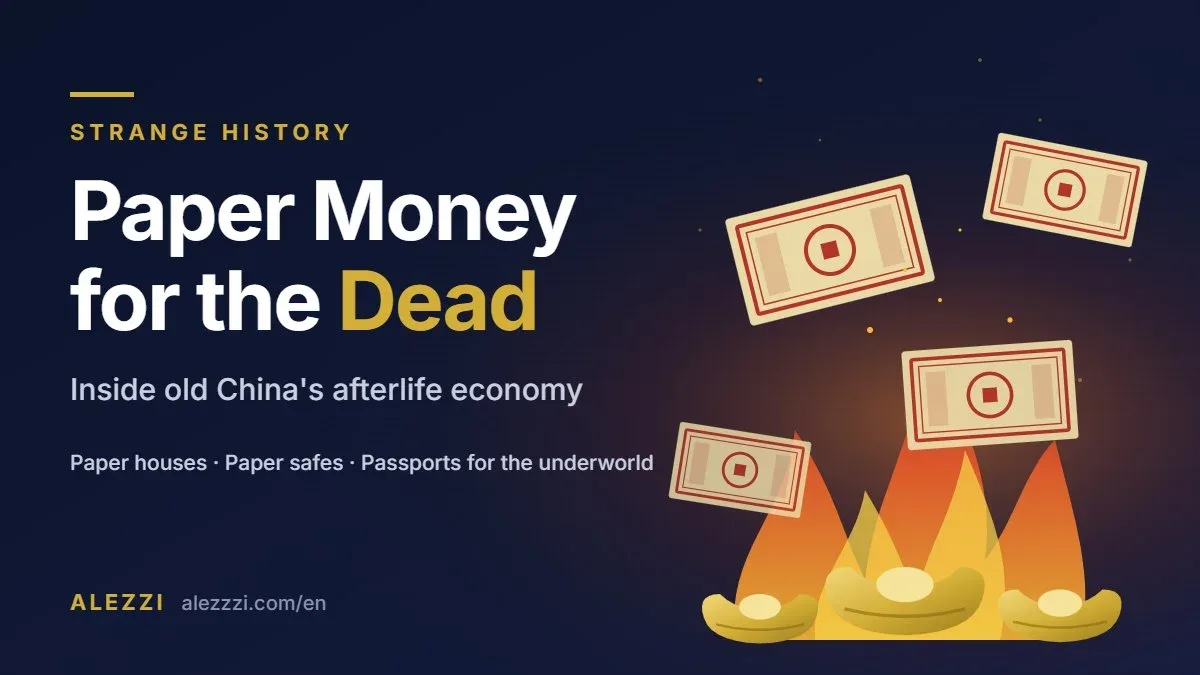
When someone died in old China, their family did not simply say goodbye. They went shopping. Paper money, paper silver, a paper house with paper furniture, a paper servant holding a teapot, and even a paper passport stamped for the journey. Then they set it all on fire.
To an outsider it looks like a strange waste of paper. To the people doing it, it was the most practical thing in the world. Fire was the delivery service, and the dead were waiting on the other side for their package.
In the early 1900s, the French Jesuit missionary Henri Doré spent years recording these customs in the villages of Jiangsu and Anhui. His multi-volume work, Researches into Chinese Superstitions, describes what we might call an afterlife economy: a full system of money, goods, services and paperwork built for people who were no longer alive.
In this article
- A world below that works like a government office
- From real silver to paper silver
- The scholars who called it nonsense
- A missionary, a scholar and a pile of ash
- Paper houses, paper safes and winter coats
- Servants, sedan chairs and a bribe for the road
- Passports for the underworld
- The Hungry Ghost Festival: welfare for the forgotten dead
- Why it lasted
- More from the afterlife
A world below that works like a government office
In traditional Chinese folk belief, death was not an ending. It was a move, from the world of the living, which Chinese tradition calls yang, to the world of shadows, called yin. And the shadow world was imagined as a copy of imperial China, complete with courts, judges, officials, checkpoints and, of course, corruption.
That idea changes everything. If the dead still need a roof, clothes, food and money, and if the officials down there can be bribed, then a good son has a duty to keep sending support. The afterlife was not a paradise to escape into. It was a place where you still had bills to pay.
From real silver to paper silver
It did not start with paper. Under the Han dynasty, families buried real copper coins and silver with the dead, sometimes in enormous amounts. Doré points out where that led: tomb robbers. Chinese records describe thieves breaking into the tomb of Emperor Wen of Han to carry off the treasure buried with him.
Then came paper. Chinese tradition credits its invention to Cai Lun, a court eunuch of the Eastern Han dynasty. Over the following centuries, some people began cutting paper into the shape of coins and offering it to spirits instead of metal. For a long time this was a private habit, not a rule.
The turning point came under Emperor Xuanzong of the Tang dynasty, in the late 730s. According to the sources Doré cites, Wang Yu, the official in charge of imperial sacrifices, brought burnt paper money into state rituals. Once the court did it, everyone did it. By the Song dynasty, shops selling "spirit paper" were everywhere, offering paper gold, paper silver and cut-paper strings of cash.
Paper had quietly solved two problems at once. Families could give generously without ruining themselves, and there was nothing in the tomb worth stealing.
The scholars who called it nonsense
Not everyone was impressed. Many Confucian officials saw paper money as a vulgar invention with no roots in the classics.
Under the Song emperor Huizong, two ministers sent a petition calling the practice empty and foolish, and arguing that if spirits had any intelligence, being handed cut paper was an insult to them. When paper money was burned during the funeral of Emperor Gaozong, the crown prince reportedly scolded the officials, saying it was a Buddhist custom and that his father had no need of such things.
Even Zhu Xi, the great philosopher of Neo-Confucianism, had doubts. Burnt paper, he noted, leaves nothing but ash, and helps neither the living nor the dead. He preferred the older offerings of grain and cloth. Yet he was realistic: paper money had become the way ordinary people expressed filial love, and that was better than forgetting their parents entirely.
A missionary, a scholar and a pile of ash
Doré records a debate between Western missionaries and Chinese scholars that shows how people defended the custom. It went roughly like this.
The missionary argued that the dead have no body, feel no hunger or cold, and have no use for ash. The scholar answered that Confucius taught children to serve their dead parents as they served them in life, so a good son must provide money.
The missionary pushed back: when your father was alive, did you hand him colored paper to buy rice? Would you accept ash as payment for anything? The scholar then changed ground. Paper money, he said, is the currency of ghosts. It is used in the underworld to bribe guards and executioners and shorten the punishment of the dead.
The missionary's final point was historical. Confucius and the ancient sages never burned paper money, because paper was not invented until centuries after they died. Were they lacking in filial piety?
According to Doré, the scholars usually fell silent at this point, or admitted the real reason: custom. No family wanted to be the one accused by neighbors of neglecting their parents.
Paper houses, paper safes and winter coats
Money was only the start. In Jiangsu and Anhui, paper craftsmen built model houses on bamboo frames covered in bright colored paper. These were not rough boxes. They had guest halls, bedrooms, kitchens with pots and pans, tables, chairs and couches, plus the small comforts of daily life: tobacco pipes, teapots and, in later times, even opium pipes. The goal was simple. The dead should not lose their habits.
The paper house was usually burned on the forty-ninth day after death. Doré also describes something remarkable. An old man with no living sons, knowing nobody would perform the rites for him, might build and burn a paper house for himself while still alive. With it he sent a letter to a dead relative, asking them to look after the house until he arrived.
The authorities tried to stop the spending. Under the Mongol Yuan dynasty, the Board of Punishments complained that ordinary people were wasting fortunes on paper houses and figures, and an imperial decree banned them. Like earlier bans, it failed.
Because the underworld was thought to be full of thieves and greedy officials, families also burned paper safes, labeled with the name of the dead person and sealed with magic locks, so their gold and silver ingots would be kept secure.
And on the first day of the tenth month, families went to the graves to burn paper winter clothes: hats, shoes and robes, so their parents would not be cold during the winter below.
Servants, sedan chairs and a bribe for the road
A comfortable afterlife needed staff. Paper figures went into the fire with the dead: a young maid holding a teacup and teapot, a young man carrying a tobacco pipe and matches, sedan chairs with paper bearers, horses with riders, and a guide known as the boy who leads the soul. Mountains of gold and silver paper promised wealth that would never run out.
During the funeral procession, someone walked along the road scattering light paper money. This money was not burned. It was left to the wind. The belief was that hungry and wandering ghosts gathered at the roadside, and the scattered money bought the procession the right of way, so the spirits would not block it or harm the body.
Passports for the underworld
The most bureaucratic detail of all was the paperwork. Families bought printed documents on yellow paper from Buddhist or Taoist temples:
- A passport with the name and date of death, burned at the funeral so the soul could pass checkpoints without paying fees or being detained.
- A toll exemption permit, addressed to the gatekeepers of the underworld, instructing them not to delay the soul.
- A document for opening heaven, seen as a Buddhist key to release the soul from the lower courts and open the way to paradise.
In other words, the dead were expected to travel exactly as a traveler in imperial China did: with documents, stamps and a little money for the officials.
The Hungry Ghost Festival: welfare for the forgotten dead
What about the dead who had no family to send them anything? They became the hungry ghosts, and they were dangerous. People believed that neglected spirits could take revenge on the living with disease and disaster.
So the system had a public welfare program too. On the fifteenth day of the seventh month, during what is often called the Hungry Ghost Festival, the City God, seen as heaven's official in charge of the town, was believed to gather the abandoned spirits. Temples and local authorities burned piles of paper money, paper clothes and paper food for them. The aim was to keep the forgotten dead fed and calm, for the safety of the whole city.
Why it lasted
Doré's records show that this was never just a random superstition. It was a complete social system that copied the economy and bureaucracy of the living world, from currency and bribes to permits and safes, and projected it onto death.
It also did two very human things. It gave grieving families something concrete to do, a way to keep caring for their parents after the funeral. And it was cheap. Paper gold replaced real gold, so families got the same comfort without burying their savings.
Many of these customs survive today. Joss paper is still burned at Chinese graves and temples, and modern versions include paper phones, cars and credit cards. The packaging has changed. The idea, that love for the dead can still be delivered, has not.